CourtCureOnline court-related & behavioral education · courtcure.com
Course Information Sheet
Prepared October 30, 2026
Ref: CC-14947
Cannabis Awareness Course - 24 Hour
This sheet describes the course a student has enrolled in or is considering. It is provided so the court, probation officer, attorney, employer or other requiring party can decide whether the program meets their requirement before the student begins. Questions: 888-267-5556 (call or text) or [email protected].
Program overview
| Course title | Cannabis Awareness Course - 24 Hour |
| Subject area | Marijuana / THC awareness |
| Program length | 24 hours of instruction |
| Format | 100% online, self-paced, text-based lessons with knowledge checks. Available 24/7 on any phone, tablet or computer. |
| Time enforcement | Active seat time is tracked for every lesson. The student cannot complete the course in less than the stated number of hours of active participation. |
| Assessment | Knowledge checks throughout the course and a final assessment that must be passed before a certificate is issued. |
| Enrollment | Immediate upon registration. A student account records enrollment date, progress, seat time and completion. |
| Course page | https://courtcure.com/product/cannabis-awareness-course-24-hour/ |
Curriculum
- Chapter 1: Cannabis & Driving Awareness – Introduction
- Chapter 2: Cannabis Components – THC, CBD, and More
- Chapter 3: How THC Interacts with the Brain and Nervous System
- Chapter 4: Short-Term Effects of Cannabis Use
- EV – Master Conflict: Pause, Listen, Win (15-Min Video)
- Chapter 5: Long-Term Effects and Dependence Potential
- Chapter 6: Cannabis Trends – National Health and Safety Data
- Chapter 1: Respiratory Health
- Chapter 2: Cardiovascular Health
- Chapter 3: Neurological & Cognitive Effects
- EV – Change Your Mindset, Change Your Life (20-Min Video)
- Chapter 1: Cannabis and Mental Health: An Overview
- Chapter 2: Cannabis and Anxiety Disorders
- EV – Beat Stress Fast: Grounding & Coping (15-Min Video)
- Chapter 3: Cannabis and Depression
- Chapter 4: Cannabis and Psychosis/Schizophrenia
- Chapter 5: Cannabis, Suicide, and Self-Harm
- Chapter 1: Cannabis and the Law
- Chapter 2: Cannabis and Workplace and School Safety
- Chapter 3: Cannabis and Public Safety (Driving, Community Risks, Emergency Care)
- Chapter 4: Prevention and Harm Reduction Strategies
- Chapter 1: Impairment Timeline & Dose Variability (Inhaled vs. Edibles vs. Other)
- Chapter 2: Cannabis + Alcohol + Other Substances: Why Risk Multiplies
- Chapter 3: Driving Skills Affected: Attention, Time/Distance, Lane Position, Hazards
- Chapter 4: Myths and Misjudgment: “I Feel Fine,” Tolerance, and Overconfidence
- Chapter 1: Safety Planning: Transportation, Boundaries, and Safer Defaults
- Chapter 2: Traffic Stops and Roadside Processes: What to Expect (General, Non-legal advice)
- Chapter 3: After a Crash: Medical Priorities, Reporting Basics, and Long-Term Impact
- Chapter 4: Long-Term Risk Reduction: Routines, Support, and Community Resources
- Module 7 — Chapter 1: Executive Function & Decision Collapse (Why “I’m Fine” Can Be Wrong)
- Module 7 — Chapter 2: Risk Perception Distortion & Cognitive Bias (How Judgment Gets Quietly Rewired)
- Module 7 — Chapter 3: Complex Conditions & Reaction Time Variability (Why “Average” Doesn’t Protect You)
- Module 7 — Chapter 4: High-Potency Products & Modern THC Delivery (Why Today’s Cannabis Is Different)
- Module 7 Knowledge Check
- Module 8 — Chapter 1: Toxicology, Detection Windows & Impairment vs. Presence
- Module 8 — Chapter 2: Behavioral Indicators & Observational Assessment (How Impairment Is Evaluated in the Real World)
- Module 8 — Chapter 3: Civil Liability, Financial Risk & Long-Term Consequences
- Module 8 — Chapter 4: Long-Term Life Impact & Personal Stability Planning
- Module 8 Knowledge Check
- Module 9 — Chapter 1: Adolescent Brain Development & Early Exposure Risk
- Module 9 — Chapter 2: Cannabis, Sleep, Fatigue & Cognitive Performance
- Module 9 — Chapter 3: Trauma, Stress & Self-Medication Patterns
- Module 9 — Chapter 4: Social Influence, Culture & Norm Perception
- Module 9 Knowledge Check
- Module 10 — Chapter 1: Habit Loops, Behavioral Conditioning & Sustainable Change
- Module 10 — Chapter 2: Transportation Planning, Responsibility Roles & Risk Separation
- Module 10 — Chapter 3: Personal Risk Mapping & Future Commitment Planning
- Module 10 — Chapter 4: Course Integration & Long-Term Stability Strategy
- Module 10 Knowledge Check
- Module 11 — Chapter 1: Neurobiology of Executive Function & Cannabis (Part 1)
- Module 11 — Chapter 1: Neurobiology of Executive Function & Cannabis (Part 2)
- Module 11 — Chapter 2: Neural Timing, Attention Networks & Performance Variability Modeling
- Module 11 — Chapter 3: Default Mode Network, Task Switching & Cognitive Control Under Cannabis Exposure
- Module 11 — Chapter 4: Conflict Monitoring, Error Detection & Behavioral Correction Systems
- Module 11 — Chapter 5: Reward Circuitry, Reinforcement Learning & Decision Bias
- Module 11 — Chapter 6: Neuroplasticity, Recovery Potential & Long-Term Adaptation
- Module 11 — Chapter 7: High-Potency Exposure, Escalation Risk & Long-Term Executive Stability Modeling
- Module 11 Knowledge Check
- Module 12 — Chapter 1: Behavioral Economics & Decision Architecture Under Cannabis Influence
- Module 12 — Chapter 2: Impulsivity, Inhibition Control & Cognitive Load Under Stress
- Module 12 — Chapter 3: Cognitive Bias Under Intoxication — Overconfidence, Normalization & Risk Drift
- Module 12 — Chapter 4: Long-Term Risk Projection & Five-Year Outcome Modeling
- Module 12 Knowledge Check
- Module 13 — Chapter 1: Public Health Frameworks & Cannabis in Community Context
- Module 13 — Chapter 2: Healthcare Burden, Emergency Response & Acute Exposure Trends
- Module 13 — Chapter 3: Community-Level Cost Modeling, Insurance Systems & Social Impact Metrics
- Module 13 — Chapter 4: Social Impact Metrics, Workplace Cohesion & Institutional Stability
- Module 13 — Chapter 5: Cumulative Social Cost, Policy Feedback Loops & Prevention Strategy Scaling
- Module 13 Knowledge Check
- Module 14 — Chapter 1: Workplace Regulation, Federal–State Conflict & Professional Accountability Systems
- Module 14 — Chapter 2: Corporate Liability, Insurance Exposure & Risk Management Structures
- Module 14 — Chapter 3: Professional Ethics, Licensing Risk & Reputation Preservation Modeling
- Module 14 — Chapter 4: High-Responsibility Roles, Leadership Modeling & Accountability Scaling
- Module 14 Knowledge Check
- Module 15 — Chapter 1: Dependence Patterns, Habit Escalation & Psychological Reinforcement Loops
- Module 15 — Chapter 2: Withdrawal Patterns, Recovery Windows & Long-Term Habit Restructuring
- Module 15 — Chapter 3: Long-Term Stability Integration & Identity-Based Behavior Change
- Module 15 Knowledge Check
Certificate of Completion
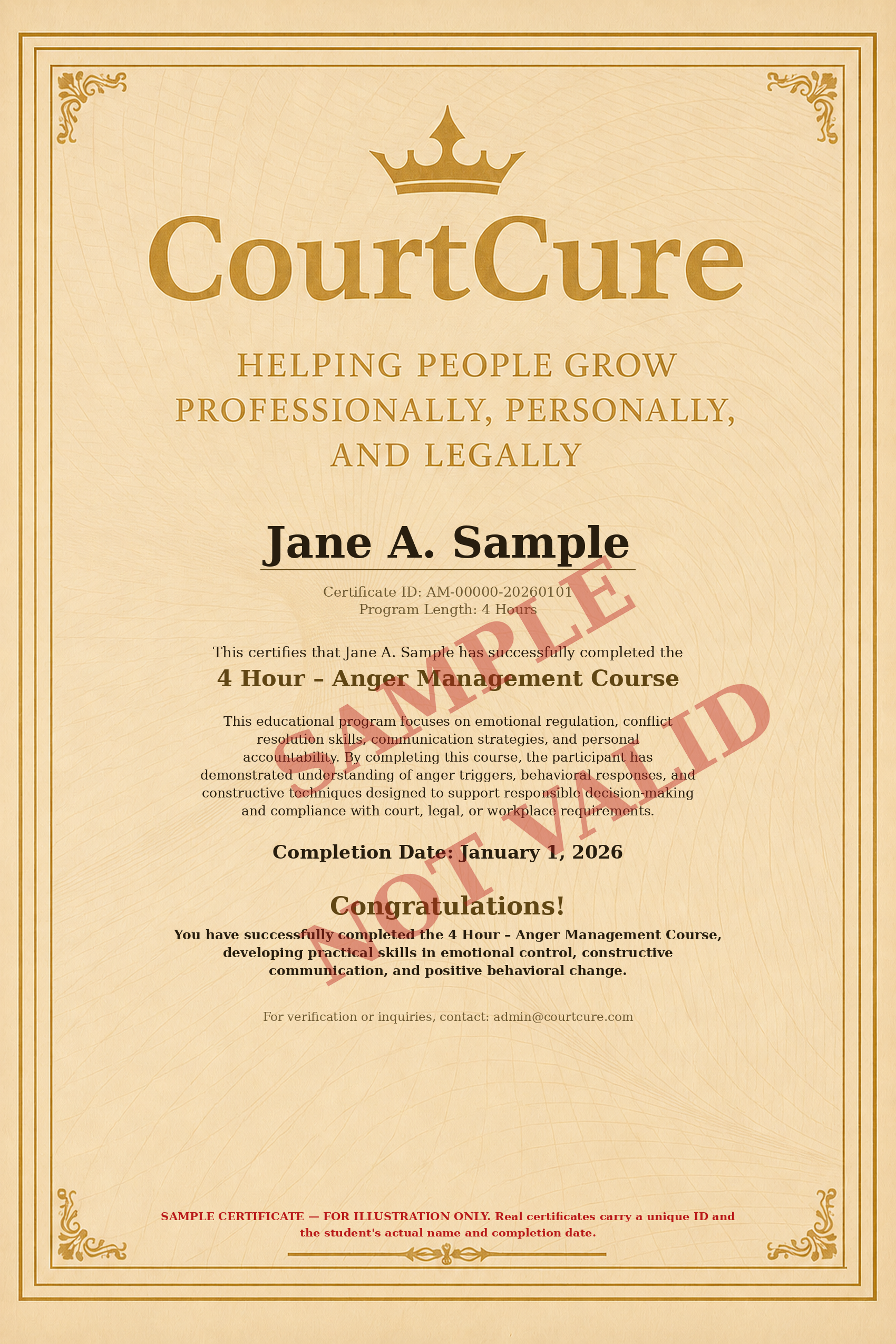
Issued immediately after the student completes all lessons, meets the required seat time and passes the final assessment. The certificate shows:
| Student | Full legal name as registered |
| Course | Course title and program length in hours |
| Completion date | Date the final assessment was passed |
| Certificate ID | A unique ID printed on every certificate |
| Verification | Any court, officer or employer can confirm a certificate at courtcure.com/verify by entering the Certificate ID. Certificates refunded or revoked are shown as invalid. |
| Delivery | PDF download, print, or email from the student dashboard. Mailed originals available on request. |
| Sample | View a sample certificate |
Provider
| Provider | Court Cure, LLC (D Lee Ventures LLC), 3223 S Loop 289, Suite 600, Lubbock, Texas 79423 |
| Contact | 888-267-5556 (call or text) · [email protected] · courtcure.com |
| Acceptance | CourtCure certificates are accepted by courts, probation departments, attorneys, employers and DOT/SAP providers across the United States. CourtCure is an online education provider and is not licensed, certified or approved by any individual court, state agency or employer. Acceptance of an online program is determined by the requiring party, which is why we recommend reviewing this sheet before the student begins. |
| Guarantee | If the requiring party does not accept the certificate, the student receives a full refund under our Refund Policy. |
Confirming acceptance
To confirm that this course satisfies a requirement, the requiring party may contact CourtCure directly, or simply advise the student in writing. If a court or agency needs a letter of enrollment, attendance record, seat-time report or any additional documentation, email [email protected] with the student’s name and we will provide it promptly.
Shareable link: https://courtcure.com/course-information/?c=14947