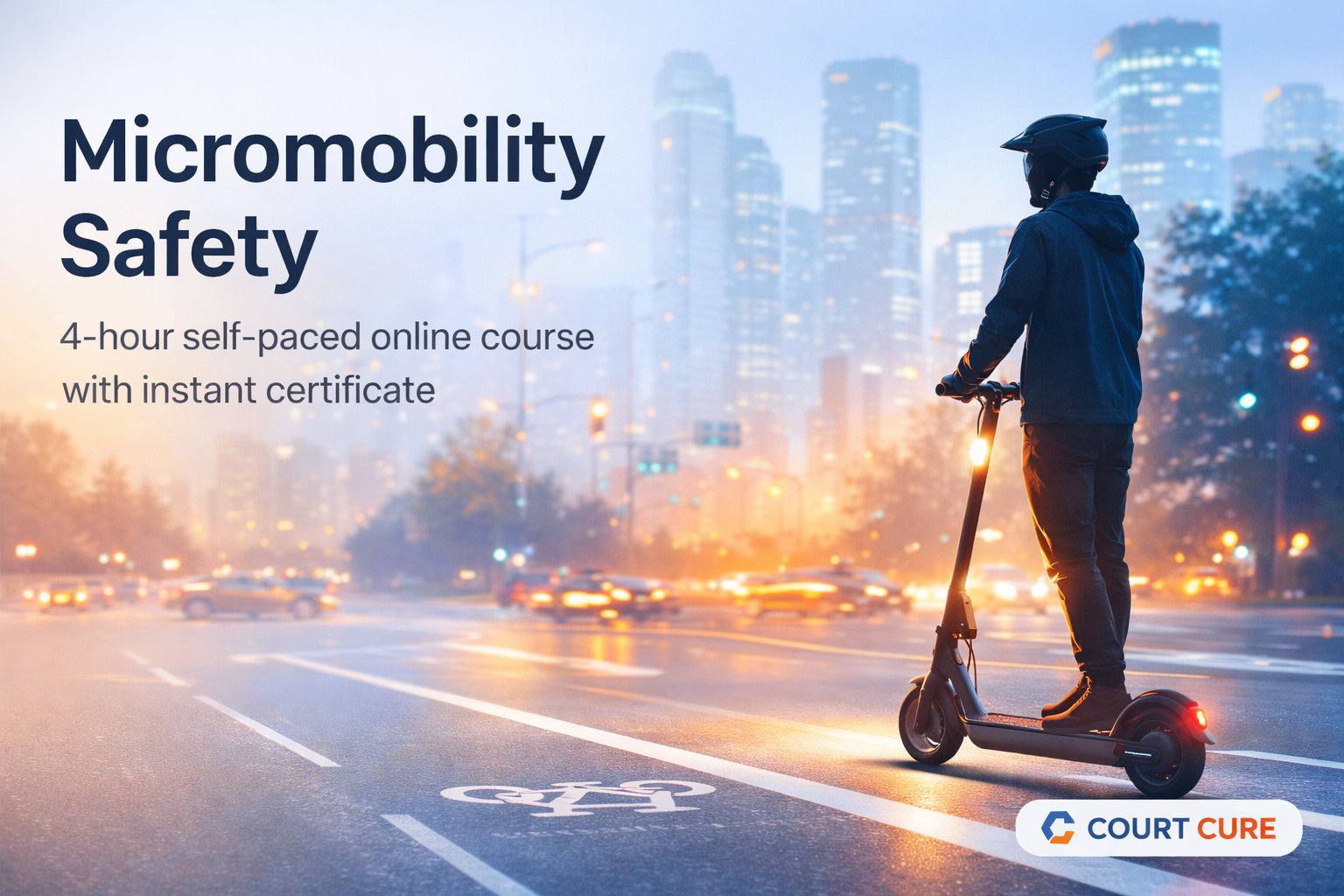
Micromobility Safety Course
Electric scooters and e-bikes move fast—often faster than the rider’s experience in traffic environments. CourtCure’s Micromobility Safety program is a structured, modern online course focused on safer choices, shared-street responsibility, and clear completion documentation.
Prefer a simple completion path? This course is designed to reduce confusion: clear topic, clear hours, clear proof at completion.
Micromobility Safety for students
If you were told to complete a safety course, the goal is usually simple: learn what matters, avoid repeat problems, and finish with documentation you can submit. This Micromobility Safety course focuses on the decisions that most often lead to incidents: speed judgment, scanning, visibility, and predictable movement.
Micromobility Safety for courts & attorneys
Reviewers typically want a program that is neutral, structured, and simple to document. CourtCure delivers a plain-language course outline, instructional-hour format, knowledge checks, and clear certificate wording.
- Designed for e-scooters, e-bikes, and similar devices
- Focuses on risk reduction and shared-street responsibility
- Clear outcomes: speed judgment, visibility, predictability, pedestrian respect
- Documentation built to be easy to interpret
Requirements can vary by jurisdiction and case specifics. This page is designed to make evaluation simple by presenting transparent course structure.
Course outline (4 instructional hours)
1) Risk & real-world riding
How incidents happen—and how to spot risk early before it stacks.
Safe Riding mindset: predictable movement reduces conflict.
2) Speed & stopping distance
Why speed multiplies risk fast, especially near pedestrians and intersections.
Core skill: slow earlier, scan more, stay in control.
3) Shared streets & pedestrians
Passing etiquette, sidewalk conflict reduction, and respect in mixed-use zones.
Scooter Safety principle: the closer the foot traffic, the slower you go.
4) Visibility & distraction
Night riding principles, attention control, and how “they didn’t see me” happens.
E-Bike Safety overlaps here—visibility is a choice.
5) Intersections & crossings
Where assumptions get expensive: scanning, yielding, and predictable crossing behavior.
Goal: fewer near-misses and sudden moves.
6) After an incident
Responsibility and next steps: stay calm, check injuries, document what happened.
Reduces escalation and repeat problems.
Assessment approach
Students complete short knowledge checks throughout the course. These reinforce practical habits rather than trick questions. The goal is comprehension: speed judgment, scanning, visibility, predictability, and pedestrian respect.
Why “Micromobility Safety” is the right standard term
The phrase already reads institutional (transportation agencies, universities), which makes it feel neutral and credible. That tone helps reviewers quickly interpret the course as structured education rather than a trendy product.
Framework support (BECI Certified)
CourtCure course structure is designed in alignment with standards-oriented framework principles published through BECI Certified: clear objectives, measurable completion, and behavior-focused outcomes. This helps reviewers evaluate content quickly and consistently.
We keep the student experience simple while keeping course structure transparent for documentation needs.
Related sites & resources
Explore our broader education and standards ecosystem:
- 702duischool.com — long-running online education platform.
- becicertified.org — frameworks and standards positioning.
- conductcourses.com — professional behavior and workplace training.
Enroll in Micromobility Safety
Price: $75 • Length: 4 instructional hours • Format: online and self-paced. Finish the program, pass the checks, and download your certificate.
CourtCure provides education and documentation. Requirements can vary by jurisdiction and case context.
FAQ
Is this course only for scooters?
No. The course is built for micromobility devices broadly—especially scooters and e-bikes—because the safety decision patterns overlap. This supports Micromobility Safety, Scooter Safety, and E-Bike Safety in one consistent program.
What if documentation needs are specific?
This page includes a clear outline and instructional-hour format to make review easier. If a specific request exists, handle it through your normal court/attorney process.
Do you offer different hour versions?
The standard program is four instructional hours. If a documented requirement differs, contact us with the request details and we’ll provide guidance on the best path.