CourtCureOnline court-related & behavioral education · courtcure.com
Course Information Sheet
Prepared October 30, 2026
Ref: CC-15707
Behavioral Health & Substance Awareness Training – 30 Hour
This sheet describes the course a student has enrolled in or is considering. It is provided so the court, probation officer, attorney, employer or other requiring party can decide whether the program meets their requirement before the student begins. Questions: 888-267-5556 (call or text) or [email protected].
Program overview
| Course title | Behavioral Health & Substance Awareness Training – 30 Hour |
| Subject area | Drug and alcohol / substance awareness |
| Program length | 30 hours of instruction |
| Format | 100% online, self-paced, text-based lessons with knowledge checks. Available 24/7 on any phone, tablet or computer. |
| Time enforcement | Active seat time is tracked for every lesson. The student cannot complete the course in less than the stated number of hours of active participation. |
| Assessment | Knowledge checks throughout the course and a final assessment that must be passed before a certificate is issued. |
| Enrollment | Immediate upon registration. A student account records enrollment date, progress, seat time and completion. |
| Course page | https://courtcure.com/product/behavioral-health-substance-awareness-training-30-hour/ |
Curriculum
- Module 1 – Chapter 1 – Youth Brain Development and Risk: Why Underage Use Hits Harder
- Module 1 – Chapter 2 – Peer Influence Online and Offline: How Pressure Works
- Module 1 – Chapter 3 – Family Systems and Prevention: What Reduces Long-Term Risk
- Module 1 – Chapter 4 – Early Warning Signs and Early Action: When to Get Help
- CHAPTER 5 – Youth, Peer Pressure, and Alcohol
- Module 2 – Chapter 2 – Treatment and Support Options: Counseling, Programs, Peer Support
- Module 2 – Chapter 3 – Relapse Patterns and Return to Safety: Why Setbacks Happen
- Module 2 – Chapter 4 – Recovery Environment: Routines, Relationships, Accountabilitys a Toll On Your Family Your Friends and You!
- Module 3 – Chapter 1 – Impairment and Decision-Making: Perception, Reaction, Fatigue
- Module – 3 – Chapter 2 – High-Risk Situations: Parties, Driving, and Split-Second Choices
- Module 3 – Chapter 3 – Planning for Safety: Transportation, Boundaries, and Prevention
- Module 3 – Chapter 4 – Long-Term Consequences: Health, Work, Family, Financial Costs
- Module 4 – Chapter 1 – Community Resources: Finding Help That Fits Your Situation
- Module 4 – Chapter 2 – Rebuilding Trust After Substance Harm: Patterns That Work
- Module 4 – Chapter 3 – Building a Safer Life: Environment, Peers, and Support
- Module 4 – Chapter 4 – Long-Term Resilience: Protective Factors That Hold Up
- Module 5 – Chapter 1 – The Brain and Behavior: Reward, Tolerance, Dependence
- Module 5 – Chapter 2 – Alcohol and the Body: Short- and Long-Term Effects
- Module 5 – Chapter 3 – Drug Categories and Their Effects: Depressants, Stimulants, Opioids, Cannabis
- Module 5 – Chapter 4 – Polysubstance and Interactions: Why Mixing Increases Risk
- Understanding the Continuum From Use to Dependence
- Foundations of Behavioral Health & Substance Awareness Assessment
- How Genetics, Environment, and Experience Shape Risk
- Protective Factors That Reduce Long-Term Harm
- Recognizing Early Behavioral and Emotional Warning Signs
- Why Prevention Works Best Before Crisis
- How Alcohol Affects the Brain and Nervous System
- Blood Alcohol Concentration and Impairment
- Short-Term Risks: Judgment, Coordination, and Injury
- Long-Term Alcohol Use and Physical Health
- Making Safer Decisions Around Alcohol
- How THC Affects Perception, Memory, and Reaction Time
- Edibles, Concentrates, and High-Potency Products
- Cannabis and Mental Health Vulnerability
- Driving, Workplace Safety, and Cannabis Impairment
- Recognizing Problematic Cannabis Use
- How Stimulants Affect Energy, Mood, and Judgment
- Cocaine Use and Acute Cardiovascular Risk
- Methamphetamine and Long-Term Brain Changes
- Stimulant-Induced Anxiety, Paranoia, and Aggression
- Treatment and Recovery From Stimulant Use
- Understanding Prescription and Illicit Opioids
- Tolerance, Dependence, and Withdrawal
- Why Fentanyl Has Changed Overdose Risk
- Recognizing and Responding to an Opioid Overdose
- Medication-Assisted Treatment and Recovery
- How Substance Use Changes Family Roles
- Substance Categories & Their Effects Assessment
- Trust, Secrecy, and Broken Agreements
- Parenting Challenges and Child Development
- Codependency, Enabling, and Healthy Support
- Rebuilding Family Stability Over Time
- How Social Norms Shape Substance Decisions
- Direct and Indirect Peer Pressure
- Social Media, Identity, and Substance Promotion
- Choosing Supportive Relationships
- Responding Assertively to Pressure
- Attendance, Performance, and Reliability
- Safety-Sensitive Work and Impairment
- Academic Consequences and Lost Opportunity
- Community Harm and Public Responsibility
- Professional Repair and Return-to-Work Planning
- Impairment and Reaction Time
- Alcohol, Cannabis, and Drugged Driving
- Planning Transportation Before Use
- Legal and Financial Consequences of Impaired Driving
- Building a Personal No-Impaired-Driving Commitment
- Understanding Court and Probation Expectations
- Fines, Fees, Insurance, and Employment Costs
- How Substance-Related Records Affect Opportunity
- Taking Responsibility Without Shame
- Using Consequences as Motivation for Change
- Benzodiazepines and Central Nervous System Depression
- Mental Health, Stress, and Substance Use Assessment
- Risks of Mixing Sedatives With Alcohol or Opioids
- Prescription Misuse and Accidental Dependence
- Withdrawal Risks and the Need for Medical Supervision
- Safe Medication Practices and Communication With Providers
- How Hallucinogens Alter Perception and Thought
- Dissociative Drugs and Detachment From Reality
- Psychological Risks and Unpredictable Reactions
- Novel Psychoactive Substances and Unknown Potency
- Reducing Harm Through Accurate Information
- Why Combining Substances Increases Risk
- Alcohol and Medication Interactions
- Stimulant and Depressant Combinations
- Hidden Ingredients and Contaminated Drug Supplies
- Creating a Personal Interaction-Risk Plan
- Understanding Co-Occurring Disorders
- Anxiety, Panic, and Substance Use
- Depression, Hopelessness, and Self-Medication
- Trauma, Stress, and Coping Through Substances
- Why Integrated Treatment Improves Outcomes
- How Chronic Stress Changes Behavior
- Healthy and Unhealthy Coping Patterns
- Building Distress Tolerance Without Substances
- Grounding and Relaxation Skills
- Creating a Sustainable Stress-Management Routine
- Family, Social, Legal, and Public Safety Assessment
Certificate of Completion
Issued immediately after the student completes all lessons, meets the required seat time and passes the final assessment. The certificate shows:
| Student | Full legal name as registered |
| Course | Course title and program length in hours |
| Completion date | Date the final assessment was passed |
| Certificate ID | A unique ID printed on every certificate |
| Verification | Any court, officer or employer can confirm a certificate at courtcure.com/verify by entering the Certificate ID. Certificates refunded or revoked are shown as invalid. |
| Delivery | PDF download, print, or email from the student dashboard. Mailed originals available on request. |
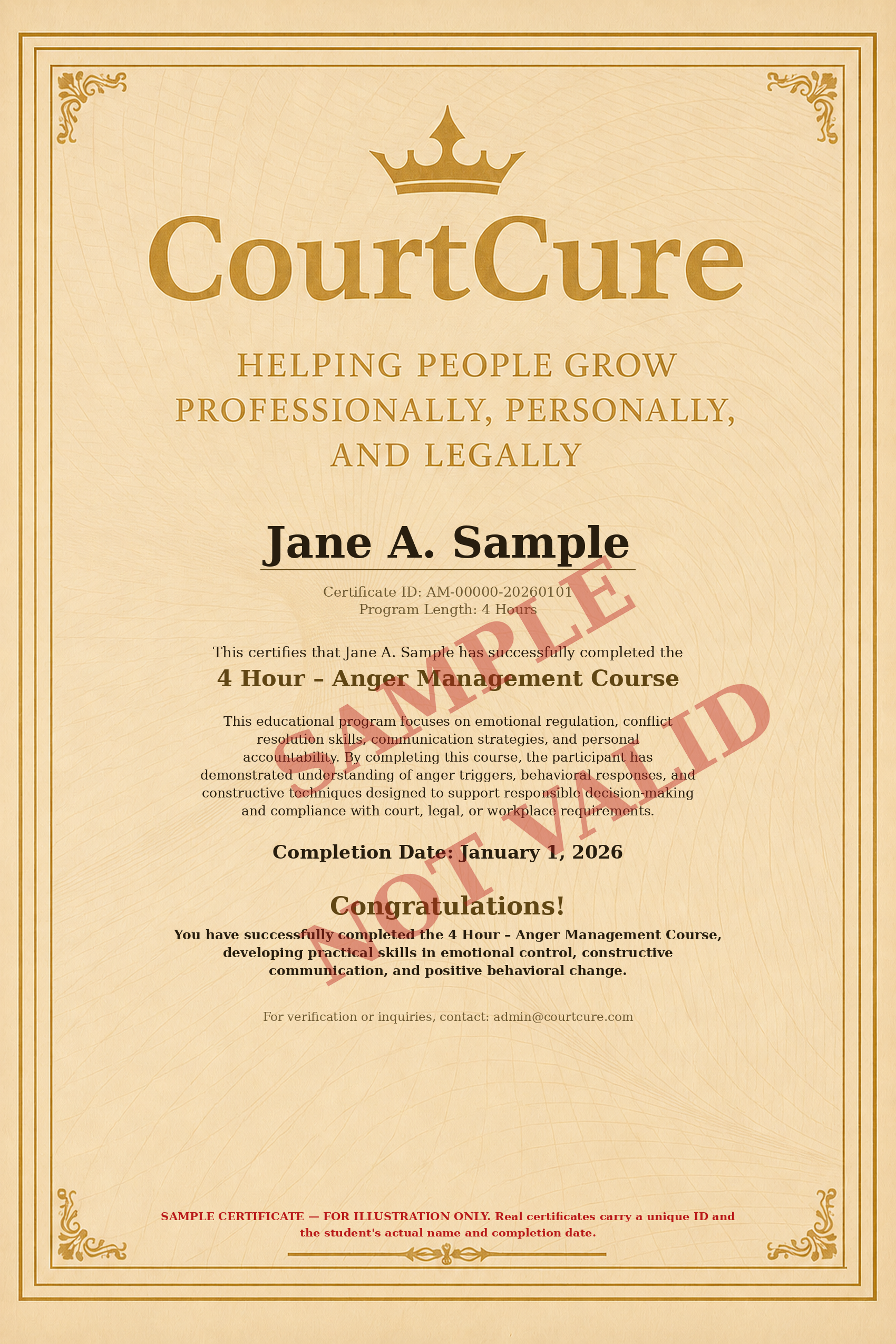
| Sample | View a sample certificate |
Provider
| Provider | Court Cure, LLC (D Lee Ventures LLC), 3223 S Loop 289, Suite 600, Lubbock, Texas 79423 |
| Contact | 888-267-5556 (call or text) · [email protected] · courtcure.com |
| Acceptance | CourtCure certificates are accepted by courts, probation departments, attorneys, employers and DOT/SAP providers across the United States. CourtCure is an online education provider and is not licensed, certified or approved by any individual court, state agency or employer. Acceptance of an online program is determined by the requiring party, which is why we recommend reviewing this sheet before the student begins. |
| Guarantee | If the requiring party does not accept the certificate, the student receives a full refund under our Refund Policy. |
Confirming acceptance
To confirm that this course satisfies a requirement, the requiring party may contact CourtCure directly, or simply advise the student in writing. If a court or agency needs a letter of enrollment, attendance record, seat-time report or any additional documentation, email [email protected] with the student’s name and we will provide it promptly.
Shareable link: https://courtcure.com/course-information/?c=15707