CourtCureOnline court-related & behavioral education · courtcure.com
Course Information Sheet
Prepared October 30, 2026
Ref: CC-13812
Parenting & Family Skills - 24 Hours
This sheet describes the course a student has enrolled in or is considering. It is provided so the court, probation officer, attorney, employer or other requiring party can decide whether the program meets their requirement before the student begins. Questions: 888-267-5556 (call or text) or [email protected].
Program overview
| Course title | Parenting & Family Skills - 24 Hours |
| Subject area | Parenting and family skills |
| Program length | 24 hours of instruction |
| Format | 100% online, self-paced, text-based lessons with knowledge checks. Available 24/7 on any phone, tablet or computer. |
| Time enforcement | Active seat time is tracked for every lesson. The student cannot complete the course in less than the stated number of hours of active participation. |
| Assessment | Knowledge checks throughout the course and a final assessment that must be passed before a certificate is issued. |
| Enrollment | Immediate upon registration. A student account records enrollment date, progress, seat time and completion. |
| Course page | https://courtcure.com/product/parenting-family-skills-24-hours/ |
Curriculum
- Module 1: Healthy Communication and Emotional Awareness — Lesson 1: Listening & Validation
- Module 1: Healthy Communication and Emotional Awareness — Lesson 2: Emotion Coaching and Naming Feelings
- Module 1: Healthy Communication and Emotional Awareness — Lesson 3: Conflict De‑escalation and Problem‑Solving
- Module 1: Healthy Communication and Emotional Awareness — Lesson 4: Repairing After Conflict
- EV – Do Right When No One’s Watching (Integrity) (17-Min Video)
- Module 2: Understanding Child Development — Lesson 1: Birth–5 Basics: Attachment, Tantrums, Time‑In
- Module 2: Understanding Child Development — Lesson 2: Ages 6–10: Routines, Chores, Motivation
- Module 2: Understanding Child Development — Lesson 3: Tweens 11–13: Autonomy Within Limits
- Module 2: Understanding Child Development — Lesson 4: Teens 14–17: Risk, Decisions, and Digital Life
- EV – Say No, Build Control: Your New Structure (17-Min Video)
- Module 3: Positive Discipline Techniques — Lesson 1: Consistency—Rules and Routines that Stick
- Module 3: Positive Discipline Techniques — Lesson 2: Natural and Logical Consequences
- Module 3: Positive Discipline Techniques — Lesson 3: Time‑In vs. Time‑Out—When and How
- Module 3: Positive Discipline Techniques — Lesson 4: Teaching Skills: Prompting, Rehearsal, Labeled Praise
- EV – Change Your Mindset, Change Your Life (20-Min Video)
- Module 4: Co‑Parenting and Family Cooperation — Lesson 1: Child‑First Co‑Parenting Basics and BIFF
- Module 4: Co‑Parenting and Family Cooperation — Lesson 2: Calendars, Exchanges, and Documentation
- Module 4: Co‑Parenting and Family Cooperation — Lesson 3: Parallel vs. Cooperative Co‑Parenting
- Module 4: Co‑Parenting and Family Cooperation — Lesson 4: Boundaries, No‑Triangle Rules, and High‑Conflict Situations
- EV – Master Conflict: Pause, Listen, Win (15-Min Video)
- Module 5: Stress Management for Parents — Lesson 1: Nervous System Basics and the Window of Tolerance
- Module 5: Stress Management for Parents — Lesson 2: Flooding and 60‑Second Resets
- Module 5: Stress Management for Parents — Lesson 3: Thinking Traps, CBT‑Lite, and Short Scripts
- Module 5: Stress Management for Parents — Lesson 4: Burnout Prevention: Sleep, Food, Movement
- EV – Break Cycles Fast: Triggers → New Patterns (20-Min Video)
- Module 6: Building a Safe, Supportive Home Environment — Lesson 1: Routine Design: Mornings, Homework, Bedtimes
- Module 6: Building a Safe, Supportive Home Environment — Lesson 2: Safety Storage: Meds, Alcohol, Cannabis, Firearms
- Module 6: Building a Safe, Supportive Home Environment — Lesson 3: Screens, Technology, and Online Safety
- Module 6: Building a Safe, Supportive Home Environment — Lesson 4: Building Trust, Rituals, and Family Meetings
- EV – Beat Stress Fast: Grounding & Coping (15-Min Video)
- Module 7: Family Systems and Parenting Styles — Lesson 1: Family Systems: Patterns, Roles, and How Change Happens
- Module 7: Lesson 2: Parenting Styles: Authoritative, Permissive, Authoritarian, Uninvolved
- Module 7: Lesson 3: Boundaries and Emotional Triangles in Family Life
- Module 7: Lesson 4: Attachment Across Ages: Connection, Rupture, and Repair
- Module 8: Lesson 1: Difficult Conversations: Tone, Timing, and Structure
- Module 8: Lesson 2: Defensiveness, Withdrawal, and Escalation Cycles
- Module 8: Lesson 3: Apologies, Accountability, and Trust Rebuilding
- Module 8: Lesson 4: Family Change Events: Moves, Separation, Loss, New Partners
- Module 9: Emotional Regulation and Co-Regulation , Lesson 1: Co-Regulation: Why Calm Spreads and Stress Spreads
- Module 9: Lesson 2: Anger, Fear, Shame: Hidden Drivers of “Bad Behavior”
- Module 9: Lesson 3: Parent Triggers: Stress Physiology and Fast Escalations
- Module 9: Lesson 4: Repair After Big Reactions: Restoring Safety and Trust
- Module 10: Lesson 1: Motivation and Follow-Through: What Works Long-Term
- Module 10: Lesson 2: Executive Function: Attention, Planning, and Self-Control
- Module 10: Lesson 3: Social Development: Friendships, Belonging, Conflict
- Module 10: Lesson 4: Partnering with Schools: Communication and Advocacy
- Module 11: Lesson 1: Anxiety and Avoidance: How It Looks in Real Families
- Module 11: Lesson 2: Oppositional Patterns vs. Skill Deficits: A Clear Distinction
- Module 11: Lesson 3: Sleep, Food, Movement: Behavior Multipliers and Stability
- Module 11: Lesson 4: When Behavior Is Communication: Needs, Safety, Support
- Module 12: Lesson 1: Neurodiversity Basics: What It Means (and What It Doesn’t)
- Module 12: Lesson 2: Sensory Needs and Overload: Preventing Meltdowns
- Module 12: Lesson 3: Flexibility with Structure: Routines That Don’t Break People
- Module 12: Lesson 4: Supporting Independence: Skills, Scaffolding, Confidence
- Module 13: Lesson 1: Blended Family Dynamics: Roles, Time, Expectations
- Module 13: Lesson 2: Grandparents and Extended Family: Support vs Undermining
- Module 13: Lesson 3: Culture, Values, and Parenting Conflict: Navigating Differences
- Module 13: Lesson 4: Family Identity: Traditions, Rituals, Belonging
- Module 14: Lesson 1: Digital Childhood: Online Social Life, Risks, Reality
- Module 14: Lesson 2: Media, Gaming, and Attention: Managing Without War
- Module 14: Lesson 3: Safety Beyond the Home: Community, Peers, Environments
- Module 14: Lesson 4: Resilience Over Time: Protective Factors That Hold Up
- Final Quiz: Parenting and Family Skills
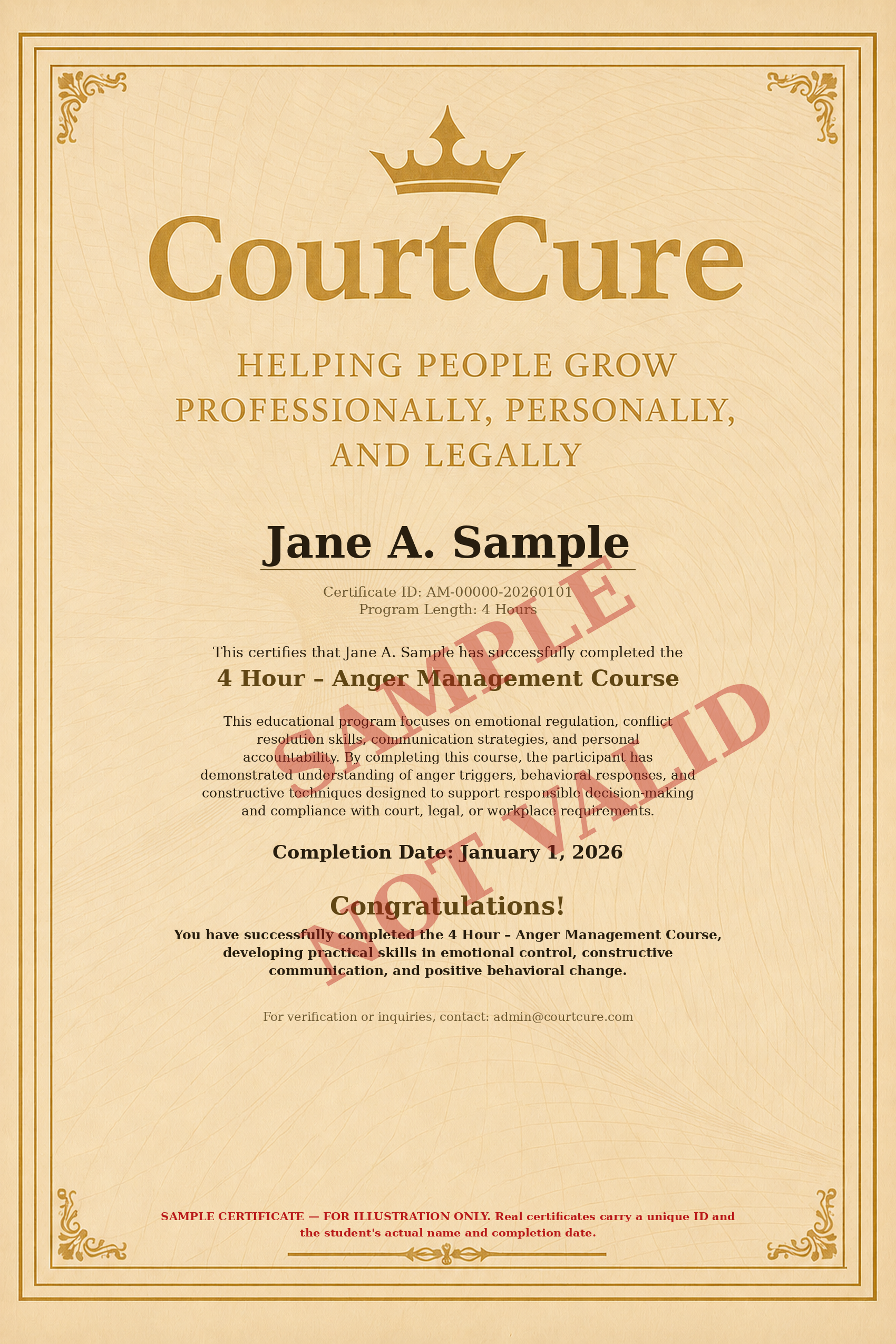
Certificate of Completion
Issued immediately after the student completes all lessons, meets the required seat time and passes the final assessment. The certificate shows:
| Student | Full legal name as registered |
| Course | Course title and program length in hours |
| Completion date | Date the final assessment was passed |
| Certificate ID | A unique ID printed on every certificate |
| Verification | Any court, officer or employer can confirm a certificate at courtcure.com/verify by entering the Certificate ID. Certificates refunded or revoked are shown as invalid. |
| Delivery | PDF download, print, or email from the student dashboard. Mailed originals available on request. |
| Sample | View a sample certificate |
Provider
| Provider | Court Cure, LLC (D Lee Ventures LLC), 3223 S Loop 289, Suite 600, Lubbock, Texas 79423 |
| Contact | 888-267-5556 (call or text) · [email protected] · courtcure.com |
| Acceptance | CourtCure certificates are accepted by courts, probation departments, attorneys, employers and DOT/SAP providers across the United States. CourtCure is an online education provider and is not licensed, certified or approved by any individual court, state agency or employer. Acceptance of an online program is determined by the requiring party, which is why we recommend reviewing this sheet before the student begins. |
| Guarantee | If the requiring party does not accept the certificate, the student receives a full refund under our Refund Policy. |
Confirming acceptance
To confirm that this course satisfies a requirement, the requiring party may contact CourtCure directly, or simply advise the student in writing. If a court or agency needs a letter of enrollment, attendance record, seat-time report or any additional documentation, email [email protected] with the student’s name and we will provide it promptly.
Shareable link: https://courtcure.com/course-information/?c=13812